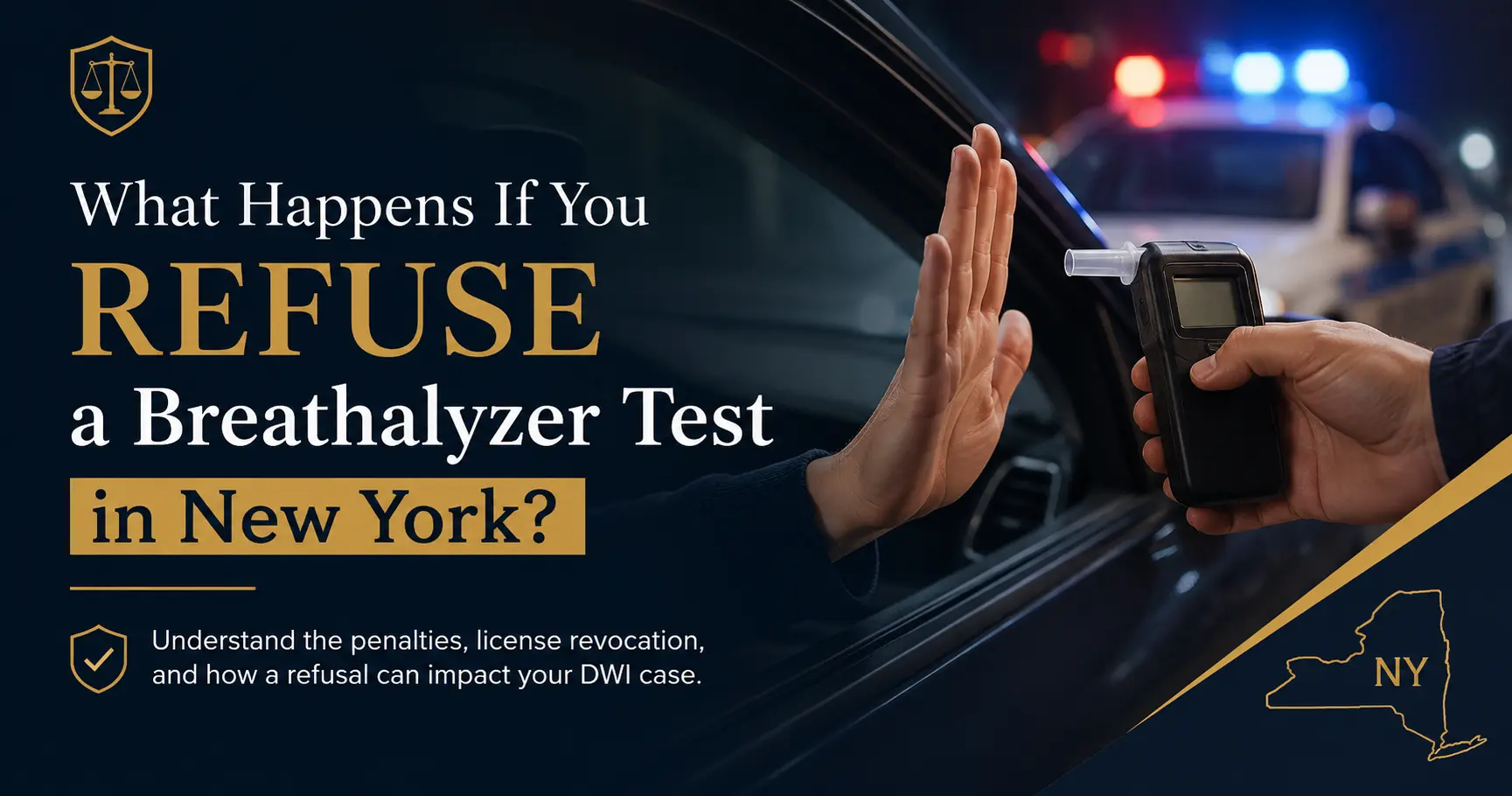
New York drivers are often surprised to learn that saying no to a breathalyzer doesn’t make a DWI stop go away. Under the state’s implied consent law, refusing a chemical test triggers its own set of consequences, separate from — and sometimes harsher than — the criminal case itself. Anyone stopped for suspected drunk driving in Albany or elsewhere in New York should understand how a refusal is handled, what it costs, and how it can affect a later court case. Here’s what actually happens after a refusal under New York law.
Does New York Law Really Require You to Take a Breathalyzer?
Under New York’s implied consent law, Vehicle and Traffic Law Section 1194, anyone who drives on a public road in the state is considered to have already agreed to take a chemical test if a police officer has reasonable grounds to believe they were driving while intoxicated or impaired. The test can measure blood alcohol content through breath, blood, urine, or saliva. Refusing is legally possible, but it’s treated as its own violation with its own penalties. Before administering the test, an officer must warn the driver that refusal will lead to license suspension and, if confirmed at a hearing, revocation — regardless of what happens with any criminal charge.
What Happens Right After You Refuse?
When a driver refuses a chemical test, the arresting officer typically takes the driver’s license on the spot and issues a temporary paper permit valid for a limited period. The officer files a report with the New York State Department of Motor Vehicles describing the refusal. That report starts a separate administrative process at the DMV, apart from any criminal charges filed in court. The driver is entitled to a hearing before the temporary permit expires. Missing that window can mean the license is suspended without ever getting the chance to challenge the refusal.
What Happens at the DMV Refusal Hearing?
The refusal hearing is held before an administrative law judge at the DMV, not a criminal court judge, and it looks only at a narrow set of questions: whether the officer had reasonable grounds to make the arrest, whether the driver was clearly warned about the consequences of refusing, and whether the driver actually refused to submit to the test. It does not decide guilt or innocence on the underlying DWI charge. Because the standards and evidence at this hearing differ from a criminal trial, a driver can lose a DMV refusal hearing and still have a strong defense in the criminal case, or the reverse. Preparing for it separately, and quickly, matters.
How Long Will Your License Be Revoked, and What Does It Cost?
For a first refusal, New York sets a civil penalty of $500 (or $550 for commercial drivers) and a minimum license revocation of one year, or 18 months for commercial drivers. If the refusal happens within five years of a prior alcohol- or drug-related driving conviction or refusal, the civil penalty rises to $750, and the revocation period extends to at least 18 months. Drivers under 21 face revocation until at least age 21. These are administrative penalties imposed by the DMV, and they apply whether or not a criminal DWI charge ends in a conviction.
Can a Refusal Be Used Against You in Criminal Court?
Yes. Under Vehicle and Traffic Law Section 1194, evidence that a driver refused a chemical test can be introduced at a criminal trial for a DWI-related charge, as long as the driver received the required warnings and the refusal was persistent. Prosecutors may point to a refusal as circumstantial evidence, though a jury isn’t required to draw any particular conclusion from it. How much weight it carries depends heavily on the facts of the stop, the wording of the warnings given, and how the arrest was conducted — details a defense attorney reviews closely in every refusal case.
Is Refusing the Right Choice?
There’s no single right answer, and no attorney can promise a particular outcome. Some drivers refuse hoping to avoid providing a BAC number at all; others don’t realize a refusal carries its own automatic penalties regardless of whether they were actually impaired. Because the decision happens in the middle of a stressful roadside stop, it’s rarely made with full information. What matters afterward is acting quickly: requesting a hearing on time and getting a clear picture of both the administrative and criminal consequences at once.
What to Do If You Already Refused
Anyone who has refused a chemical test in New York should request a DMV hearing right away, since the deadline tied to the temporary permit is short. It also helps to write down details of the stop while they’re fresh — where it happened, what was said, and how the test was offered. A criminal defense attorney can request the hearing on the driver’s behalf, review the officer’s report, and start building a strategy for both the DMV matter and any related DWI charge in court.
Frequently Asked Questions
Is refusing a breathalyzer a crime in New York?
No. Refusal is a civil, administrative violation handled by the DMV, not a separate criminal offense. It can still lead to license revocation and a civil penalty, and it can be used as evidence in a related DWI prosecution.
Can I still get a conditional license after a refusal-related revocation?
Conditional licenses, which allow limited driving for work or medical needs, are generally not available for a chemical test refusal revocation the same way they may be for some DWI convictions. Eligibility depends on the specific record and circumstances.
Is refusing a field sobriety test the same as refusing a chemical test?
No. Field sobriety tests, like walking a straight line, are voluntary, and declining one doesn’t trigger DMV penalties. A chemical test — breath, blood, urine, or saliva — is what falls under the implied consent law.
Does refusing automatically mean a DWI conviction?
No. The DMV refusal penalty and the criminal DWI charge are separate proceedings with different standards of proof. A refusal alone doesn’t establish guilt on the DWI charge.
How quickly do I need to request a refusal hearing?
The hearing generally must be requested before the temporary permit issued at the time of arrest expires, so acting within days, not weeks, matters.
Can out-of-state drivers face these penalties in New York?
Yes. Anyone driving on New York roads is subject to the state’s implied consent law, regardless of where their license was issued.
Conclusion
A breathalyzer refusal in New York sets off two separate legal processes at once: a DMV administrative case and, often, a criminal DWI case, each with its own deadlines and standards. The penalties are real even without a conviction, and the short hearing window leaves little room to wait. Anyone facing a refusal-related license action or DWI charge in the Albany area can benefit from speaking with a criminal defense attorney promptly, before key deadlines pass and evidence becomes harder to gather. Contact Robert G. Babcock for a free, confidential case review.

2 Responses